
Senior Congress leader Shashi Tharoor has articulated India's position on BRICS, advocating for it to be a "non-West, but not anti-West" platform, a stance he believes is crucial for India's national interest. He highlighted the prestige of hosting the BRICS summit, India's responsibility to represent the Global South, and the significance of bilateral meetings, particularly with China and Russia. Tharoor also addressed the strained India-China relations, citing border issues and trade leverage, and discussed the challenges within BRICS, including difficulties in achieving consensus on global issues and trade imbalances, while also considering the need for diversified international relations amidst unpredictable US sanctions.

China has voiced strong opposition to India's recent decision to standardise names for 28 strategic locations and geographical features in Ladakh.

India has rejected China's objection to New Delhi's standardisation of names for 28 places and features in Ladakh, reiterating that Ladakh is an "integral and inalienable" part of India. China had strongly opposed the move, calling India's establishment of the Union Territory and the naming "illegal and void".

India and China are in what experts call 'a cooperation-versus-competition situation'.

Xi's bilateral meeting with Modi was substantial and readouts from both sides gave indications of rapprochement, if not a reset of bilateral relations between India and China, notes Ambassador T P Sreenivasan.

India has accumulated experience organically and in public, through blood, sweat and toil -- one commissioning and one agreement at a time -- and is called a regional power. China has accumulated hulls, by misdirecting its industrial capacity, and is mistakenly called a superpower. The Indo-Japan defence agreement pushes this theory to its limits without ever naming the dragon in the room, points out Dr Abhishek Puri.

In July, tension emerged in Taksing, a remote village in the Upper Subansiri district of Arunachal Pradesh after locals sighted PLA soldiers.

Bangladesh-China and Bangladesh-US relations have evolved from reluctant engagement to increasingly consequential strategic partnerships.

China has issued a Level-IV alert due to a newly formed barrier lake at the Tibet-Nepal border, warning of a high risk of breaching and flooding downstream areas. The lake, formed at the confluence of Chhochen Khola and Purepu Tsangpo rivers, has accumulated an estimated two million cubic metres of water, with inflows expected to increase, raising concerns for areas including Gyirong Port.

Indian and Chinese armies held their first high-level commanders' flag talks in the Arunachal Pradesh sector, following Special Representatives dialogue. These talks, aimed at maintaining peace along the Line of Actual Control, occurred amidst reports of aggressive military posturing and just days before Chinese President Xi Jinping's visit to India for the BRICS summit.

Navigating this geopolitical minefield requires a cold-blooded blend of immediate tactical pleading, structural domestic diversification, and aggressive collective resistance, suggests Ambassador Rajasekhar.

Former Army chief General Manoj Naravane asserted that while India's immediate attention is on Pakistan due to terrorism, China will be New Delhi's primary long-term competitor across political, economic, trade, and military domains, necessitating a strong military deterrence alongside dialogue.

Nepal has launched a diplomatic initiative to secure climate-related compensation from major greenhouse gas emitters, asserting that post-disaster assistance for recent deadly flash floods should be viewed as a moral and legal liability, not charity. Foreign Minister Shisir Khanal highlighted Nepal's disproportionate suffering from global warming despite negligible emissions, citing rapid glacier melt and extreme mountain disasters. The country has formally approached the Loss and Damage Fund board for urgent financial aid following a catastrophic flash flood in the Bhotekoshi river basin.

A new study published in AGU Advances reveals that extreme heat events are becoming more frequent and expanding beyond traditional summer months globally. This expansion is asymmetric, occurring earlier in spring in regions like western Europe and northwestern India, and later into autumn in areas such as the western US and eastern China. Researchers highlight the challenges this poses for human acclimatisation and community preparedness, as existing infrastructure like cooling centres are built around historical summer calendars.

India has reiterated its support for freedom of navigation and unimpeded commerce in the South China Sea, backing a 2016 international arbitral tribunal ruling that rejected China's extensive territorial claims. This stance aligns with a recent joint statement by the US, UK, and other nations, emphasising peaceful resolution of maritime disputes under UNCLOS.

India is deeply concerned by the growing consolidation of Pakistan-backed jihadi and radical Islamist groups in Bangladesh, particularly in the strategically vital Chittagong Hill Tracts, which experts warn is transforming the country into a new safe haven for these networks and posing a direct threat to India's security.

The challenge for India lies in navigating complex landscape to its best advantage. The BRICS Summit will test its navigation skills, asserts former foreign secretary Shyam Saran.

India-US ties may be strained, but abandoning the relationship is not the answer; India must deal with Washington firmly without becoming either servile or hostile, asserts Ambassador T P Sreenivasan.

A massive mudslide near the China-Nepal border in Tibet has left three people dead and 588 missing. Chinese President Xi Jinping has ordered all-out rescue efforts, with the PLA mobilising forces for search and relief operations in the affected Gyirong County. The Indian Embassy has also issued an advisory for stranded Indians.

A massive flash flood near the China-Nepal border in Tibet has left hundreds missing and caused significant casualties. Chinese Premier Li Qiang visited the affected Gyirong Township to oversee rescue and relief operations, with the PLA mobilising forces for search and rescue.

India-China border trade via Uttarakhand's Lipulekh Pass is set to resume on August 1 after a gap of more than six years, with the neighbouring country granting permission to 20 Indian traders to visit Purang (Taklakot), according to officials.

For India, the goal is not simply to host another grand diplomatic gathering. It is to prove that a diverse coalition of emerging powers can still deliver.

Prime Minister Narendra Modi cautioned against the 'weaponisation' of technology and critical minerals at the BRICS summit, advocating for cooperation to foster shared prosperity. Concurrently, Chinese President Xi Jinping announced plans for an open-source AI ecosystem for BRICS nations, positioning Beijing as a key technology partner amid global AI competition.

India's ruling Bharatiya Janata Party (BJP) is actively courting Sri Lanka's Janatha Vimukthi Peramuna (JVP), a Marxist party with strong Sinhalese nationalist roots, marking a significant shift in bilateral relations despite ideological differences. This engagement, highlighted by a recent high-profile visit by JVP leader Tilvin Silva, aims to foster cooperation on economic projects and address New Delhi's concerns over slow progress in India-aided initiatives in the island nation.

New Delhi was told it had given something up; in reality it had stopped talking about it, notes Dr Abhishek Puri.

Nepalese authorities have issued a flood alert for central, western, and eastern parts of the country as water levels in major rivers like Sun Koshi, Budhi Gandaki, Mahakali, and Marsyangdi have crossed alert and danger levels due to continuous monsoon rainfall, urging residents to remain vigilant.

US President Donald Trump is expected to sign the Lindsey O. Graham Sanctioning Russia and Iran Act of 2026 later on Friday (local time). A White House official confirmed the development to ANI without revealing further details.

This article details the quarter-century journey of BRICS, from its inception as an economic acronym by a Goldman Sachs economist to its current status as an expanded eleven-member international bloc. It highlights its growth, key historical moments, and the significance of its upcoming summit, particularly with Iran's renewed importance in discussions.

The death toll from devastating flash floods in Nepal has surged to 1,050, with nearly 4,000 people, including foreigners and security personnel, still missing. Rescuers are struggling with intermittent rainfall, rising river levels, and difficult terrain, while expert teams from India and China assist in operations, particularly at hydropower project sites where many workers are believed to be trapped in tunnels.

Russian President Vladimir Putin has proposed a new investment platform, based on the New Development Bank (NDB), to fund projects in trade, infrastructure, logistics, and technology across BRICS nations, emphasising that the grouping's expanding economic cooperation is not 'against anyone' but aims to advance members' national interests.

We are back to the 1971 moment with both China and the US supporting Pakistan, asserts Colonel Anil A Athale (retd).

Gwadar is viewed as a critical pearl in China's maritime strategy as it would give a permanent logistical footprint near an important choke point - the Strait of Hormuz and the oil rich Persian Gulf, explains Commodore Venugopal Menon (retd).
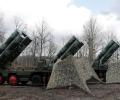
In a significant development, the Russian side has submitted a detailed proposal to the Defence Ministry in response to the Indian tender for acquiring five more squadrons of the S-400 Sudarshan long-range air defence systems for the Indian Air Force.

Any military response to a cross-border terror attack from Pakistan will have to take into account the new alignments beginning to take shape in the region, points out former foreign secretary Shyam Saran.

The death toll from devastating flash floods in Nepal has reached 1,344, with rescue teams continuing to search for approximately 5,000 missing individuals, including foreign nationals, as identification of victims proves challenging due to the condition of recovered bodies.


Nepal is grappling with the devastating aftermath of flash floods, with the death toll reaching 1,356 and nearly 5,000 people, including foreign nationals, still missing. Identification of bodies is a major challenge, with only a fraction identified so far. President Ramchandra Paudel has appealed for climate justice and national unity for relief efforts. International teams, including experts from India and China, are assisting in search and rescue, particularly at hydropower projects where workers are trapped. The country is also working to restore infrastructure and reassure tourists to protect its vital autumn tourism season.

A new report suggests China's maritime vulnerability lies in the Strait of Hormuz, not Malacca, creating strategic competition in the Indian Ocean.

The BRICS summit in New Delhi brings together leaders from major emerging economies to address global challenges like trade disputes, geopolitical upheavals, and the economic impact of conflicts in Ukraine and West Asia. India, as chair, aims to position BRICS as an economic growth engine, focusing on the Global South's food, energy, and supply chain security. The summit also highlights the grouping's expansion and its growing influence in global governance.

For the foreseeable future, the most likely outcome remains continuation of the status quo. Taiwan will remain self-governing without formally declaring independence, while China continues to apply sustained pressure short of war, predict Krishnan Srinivasan and Manoj Mohanka.
